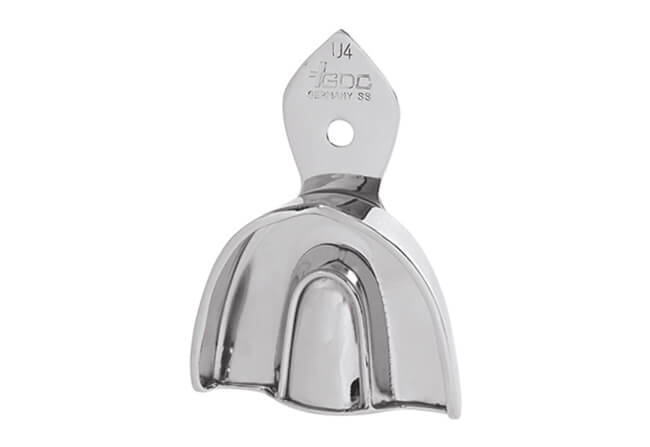
An Impression Tray Dentulous Non-Perforated Upper S is a specialized dental tool designed to capture accurate impressions of a patient’s upper arch, which is essential for creating dental molds used in various treatments such as crowns, bridges, dentures, and other prosthetics. The term “dentulous” refers to a patient with natural teeth, as opposed to an edentulous patient who has lost their teeth. The non-perforated aspect of the tray means it does not have holes, making it different from perforated trays, which are often used with materials that require more grip.
Purpose and Use of Impression Trays
Impression trays are an essential part of the dental workflow. They are used to create an impression, or a mold, of a patient’s mouth to aid in creating dental restorations or appliances. The Impression Tray Dentulous Non-Perforated Upper S is specifically designed for patients who still have their natural teeth. The “upper” designation refers to the tray being intended for the upper jaw, while “S” typically indicates a small size, suitable for individuals with smaller or more narrow dental arches.
The non-perforated feature is significant in terms of material application. When using impression materials such as alginate or silicone, the tray does not have holes, which provides a smooth, uniform surface for the material to rest on. This is ideal when the goal is to create a precise and accurate impression without the risk of material leakage through perforations. Non-perforated trays are often used when more control over the impression material is necessary, especially when dealing with more viscous or thicker impression materials.
Advantages of Non-Perforated Trays
Non-perforated trays like the Impression Tray Dentulous Non-Perforated Upper S offer several advantages. One of the key benefits is the prevention of material flow through the tray. This helps in avoiding messes and ensuring that the impression material stays in place during the procedure, reducing the chance of distortions or errors in the final mold. Non-perforated trays are particularly useful for certain types of impression materials that do not require perforation to bond effectively to the tray, ensuring a cleaner, more efficient procedure.
Furthermore, these trays often provide greater patient comfort. The smooth surface of the tray ensures there are no sharp edges or uncomfortable perforations pressing against the gums, which is crucial for maintaining a good patient experience, especially when taking impressions in sensitive areas.
Types of Impression Materials Used
The Impression Tray Dentulous Non-Perforated Upper S is commonly paired with a variety of impression materials. Alginate, one of the most popular materials, is easy to mix and fast-setting, making it ideal for preliminary impressions. More advanced materials like polyvinyl siloxane (PVS) and addition silicone are used for more detailed and durable impressions. These materials are often preferred in restorative dentistry, where precision is crucial for creating crowns, bridges, and other prosthetic devices.
Conclusion
In dental practices, the Impression Tray Dentulous Non-Perforated Upper S is an essential tool for accurately capturing the upper dental arch of patients with natural teeth. By ensuring that impression materials are held securely in place and by promoting comfort, these trays play a vital role in the creation of dental prosthetics and restorations. Whether for initial diagnostics or detailed restorative work, a non-perforated tray provides the stability and precision needed for optimal results in dental care.
₹1,300.00Original price was: ₹1,300.00.₹975.00Current price is: ₹975.00.Add to cart
You may add any content here from XStore Control Panel->Sales booster->Request a quote->Ask a question notification
At sem a enim eu vulputate nullam convallis Iaculis vitae odio faucibus adipiscing urna.
Ask an expert
We use cookies to ensure that we give you the best experience on our website. If you continue to use this site we will assume that you are happy with it.
 IMPRESSION TRAY DENTULOUS NON-...


Reviews
There are no reviews yet.