
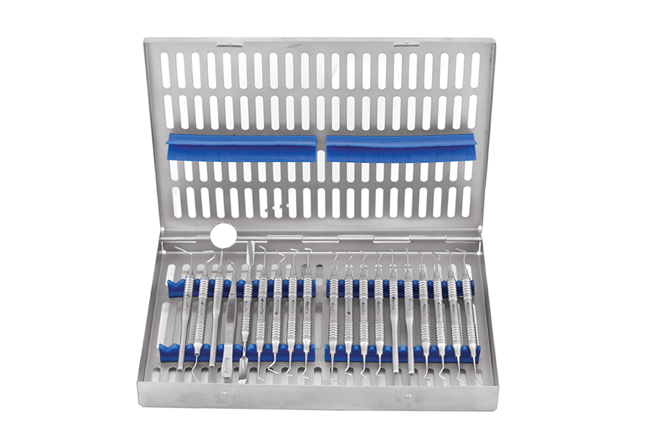
Conservative Instruments with Cassette
Conservative dental instruments are fundamental tools in dentistry, primarily used for procedures aimed at preserving the structure and health of natural teeth. These instruments, often employed in restorative dentistry, endodontics, and preventive care, help maintain dental integrity while addressing various oral health issues. The use of a cassette system to organize these instruments enhances efficiency, hygiene, and safety during dental procedures.
Types of Conservative Instruments
- Explorers and Probes
Dental explorers and periodontal probes are essential tools in conservative dentistry. The explorer, with its sharp tip, is used to detect cavities, dental caries, and other irregularities in tooth surfaces. Periodontal probes measure the depth of periodontal pockets, aiding in the diagnosis of gum diseases. - Scalers and Curettes
Scalers and curettes are primarily used for removing plaque and calculus from tooth surfaces. They are crucial for maintaining oral hygiene and preventing periodontal diseases. Curettes, with their rounded ends, are ideal for subgingival cleaning, ensuring minimal damage to the surrounding tissues. - Excavators
These instruments, often spoon-shaped, are designed to remove soft, decayed dentin from the cavity. They play a vital role in caries excavation, preparing the tooth for restorative procedures. - Burnishers and Carvers
Burnishers are used to smoothen and polish restorative materials, enhancing the aesthetics and function of the restoration. Carvers, on the other hand, shape and contour the restorative material to match the natural anatomy of the tooth. - Matrices and Wedges
These instruments assist in creating a proper form during restorative procedures. Matrices help in restoring contact points and proper contours, while wedges ensure a tight seal, preventing overhangs.
The Role of Cassettes
Cassettes are specialized trays designed to organize and sterilize dental instruments efficiently. They offer numerous advantages:
- Enhanced Sterility
Cassettes keep instruments enclosed during sterilization, minimizing the risk of contamination. This is especially critical in maintaining cross-infection control in dental clinics. - Improved Organization
Instruments are arranged systematically in cassettes, making them easy to access during procedures. This reduces chairside time and improves workflow efficiency. - Instrument Safety
The cassette’s design prevents instruments from touching each other during sterilization, reducing wear and tear and ensuring their longevity. - Time Management
Pre-arranged cassettes save time during preparation and clean-up, allowing dentists to focus on patient care.
Conclusion
Conservative instruments with cassette systems are a cornerstone of modern dentistry. They ensure precision, hygiene, and efficiency in dental practices, reflecting the commitment to preserving patients’ natural teeth and enhancing oral health. Adopting these organized systems elevates the quality of care and streamlines dental procedures.


Reviews
There are no reviews yet.