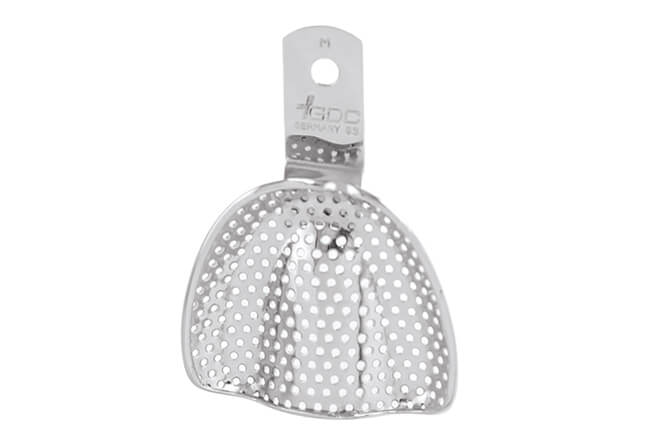
An impression tray edentulous perforated upper medium is a dental tool used to create impressions for patients who are edentulous, meaning they have no natural teeth. The tray plays a critical role in the process of designing dental prosthetics like dentures, which are custom-made to restore function and appearance for patients missing teeth. This tool is part of a broader dental treatment that aims to improve the patient’s oral health and quality of life.
Design and Functionality
The edentulous perforated upper impression tray is specifically designed for patients with no upper teeth. The tray is shaped to fit over the patient’s upper jaw, capturing the form and structure of the soft tissues and remaining bone. It helps dentists or dental technicians make precise impressions that will be used to create dentures, bridges, or other prosthetics.
What sets the perforated tray apart is its array of small holes across the surface. These perforations serve several purposes. First, they ensure that the impression material, usually a soft, pliable substance like alginate or polyvinyl siloxane, adheres to the tray during the impression-taking process. As the material is placed in the tray and the tray is seated in the patient’s mouth, the perforations allow the material to flow through the holes and create a detailed imprint of the oral structures. This detailed impression is essential for fabricating dentures that fit precisely and comfortably.
The medium size designation refers to the dimensions of the tray, ensuring it’s suitable for an average adult’s upper arch. Dentists can select from different sizes (small, medium, large) depending on the patient’s mouth anatomy. A medium-sized tray strikes a balance, ensuring it fits comfortably without being too large or too small for most adult patients.
Benefits of Using a Perforated Edentulous Tray
Using a perforated edentulous impression tray brings several benefits to both the patient and the dentist. The perforations allow the impression material to adhere better, preventing the material from slipping or moving during the process. This leads to more accurate impressions, which are vital for making dentures or other prosthetics that are functional and comfortable.
Moreover, the design of the tray ensures that even the soft tissues of the mouth, such as the gums, are captured in detail. This is essential for creating dentures that mimic the contours of the mouth and provide proper support for the patient’s facial structure.
Clinical Applications
The edentulous perforated upper medium tray is primarily used in the initial stages of denture fabrication. Once the tray is filled with impression material and placed in the patient’s mouth, the dentist will allow the material to set. Afterward, the tray is carefully removed, taking the impression with it. The resulting impression will be used to create a mold, which will guide the construction of the patient’s custom prosthetic.
This tool is also used in other restorative procedures where accurate impressions of the soft tissues of the mouth are necessary, including in the creation of dental appliances like palatal plates or other removable prosthetics.
Conclusion
The edentulous perforated upper medium impression tray is a vital tool in modern dentistry, particularly for patients who are edentulous. Its design allows for precise and accurate impressions that ensure the creation of dentures and other oral prosthetics that fit comfortably and function well. By providing a clear imprint of the gums and oral structure, this impression tray helps enhance the overall success of restorative dental procedures, leading to improved outcomes for patients and greater satisfaction with their prosthetic devices.
₹1,300.00Original price was: ₹1,300.00.₹975.00Current price is: ₹975.00.Add to cart
You may add any content here from XStore Control Panel->Sales booster->Request a quote->Ask a question notification
At sem a enim eu vulputate nullam convallis Iaculis vitae odio faucibus adipiscing urna.
Ask an expert
We use cookies to ensure that we give you the best experience on our website. If you continue to use this site we will assume that you are happy with it.

 IMPRESSION TRAY EDENTULOUS PER...


Reviews
There are no reviews yet.